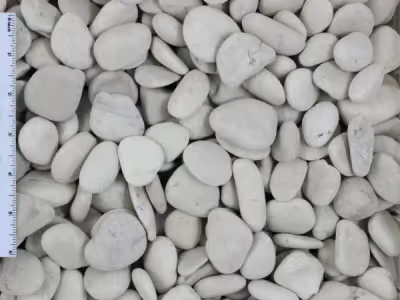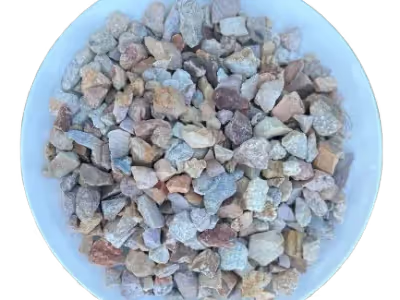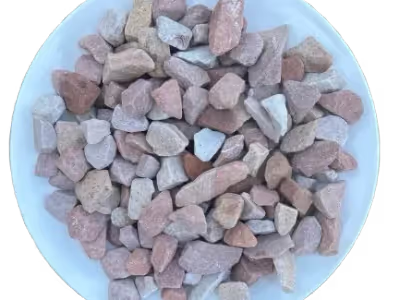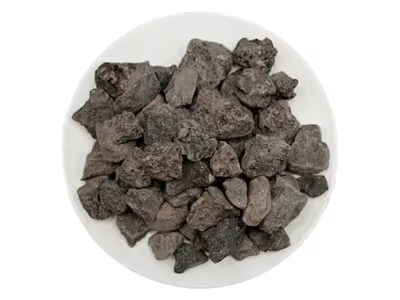
If you're choosing between river rock and pea gravel, here's the quick answer: pea gravel is small (about 3/8 inch) and smooth, which makes it comfortable for pathways and play areas, while river rock is larger (3/4 inch to several inches) and works best for decorative beds, borders, and dry creek beds. Both are rounded, fast-draining, and low-maintenance—the right pick comes down to size, how the surface will be used, and the look you want.
Below, we break down the differences we walk customers through at the yard every week, so you order the right stone the first time.
Key Takeaways
- Size is the main difference: pea gravel ≈ 3/8 inch; river rock ranges from ~3/4 inch up to several inches.
- Walkability: pea gravel is smoother underfoot; river rock is better as accent and erosion control.
- Both drain well and both want a weed barrier plus edging underneath.
- Neither compacts—don't use either as a structural base under pavers.
- Buy in bulk by the cubic yard for any area larger than a small bed.
Quick Comparison Table
| Feature | Pea Gravel | River Rock |
|---|---|---|
| Typical size | ~3/8 inch | 3/4 inch to several inches |
| Shape | Smooth, rounded | Smooth, rounded |
| Walkable | Yes—comfortable underfoot | Less so; uneven |
| Best uses | Paths, patios, dog runs, play areas | Decorative beds, dry creek beds, borders |
| Drainage | Excellent | Excellent (larger voids) |
| Compacts? | No | No |
| Edging needed | Yes | Yes |
| Look | Casual, uniform | Natural, rugged |
When to Choose Pea Gravel
Question: When is pea gravel the better choice?
Direct answer: Choose pea gravel when people (or pets) will walk on the surface, or when you want an even, casual ground cover.
Because the stones are small and smooth, pea gravel forms a relatively comfortable, consistent surface—ideal for garden paths, courtyard patios, dog runs, and play areas. It spreads easily by hand, drains quickly, and is one of the most budget-friendly decorative options. Install it 2–3 inches deep over a permeable weed barrier, and always contain it with a solid edge (steel, paver, or bender board), because the rounded stones will travel without one.
The trade-off: pea gravel shifts underfoot and won't compact, so it's not a structural base and can scatter into adjacent lawns without edging.
When to Choose River Rock
Question: When is river rock the better choice?
Direct answer: Choose river rock for decorative impact, erosion control, and dry creek beds—anywhere you want a natural, permanent look more than a walking surface.
River rock's larger, varied stones read as a natural watercourse, which makes it the go-to for dry creek beds, drainage swales, and bold bed borders. It's fire-resistant, never decomposes, and doesn't blow away or need annual topping up the way bark mulch does. Larger sizes double as erosion control on slopes and around downspouts. Like pea gravel, it performs best over fabric with clean edging, installed about 2–3 inches deep for ground cover.
Cost, Coverage, and Ordering
Both stones are sold by the cubic yard, and at 2–3 inches deep, one yard covers roughly 100–160 square feet. To size your order, use the formula in our guide on how much rock you need or our material estimator. For anything beyond a small bed, bulk is far cheaper than bagged stone.
Pricing varies by color and source—classic gravels tend to be economical, while specialty blends and larger river rock or Mexican beach pebbles cost more. Browse options on our Decorative Rocks page.
Can You Use Them Together?
Absolutely—and it often looks best. A common design pairs larger river rock and cobbles for the channel and banks of a dry creek bed with pea gravel or smaller stone filling the transitions. Mixing sizes mimics nature and adds depth.
Related Resources
- River Rock and Pea Gravel glossary entries
- How Much Rock, Gravel, or Mulch Do I Need?
- How to Build a Dry Creek Bed
- Mulch vs. Rock for landscape beds
- Using Mexican Beach Pebbles for Landscaping
- Shop Decorative Rocks
Conclusion: Match the Stone to the Job
If feet will touch it, lean pea gravel. If it's about looks, drainage features, or a dry creek bed, lean river rock. Both are durable, water-wise, and at home in Placer County landscapes—just remember fabric, edging, and a 2–3 inch depth for a clean result that lasts.
Want help choosing a size or color? Contact us or call (916) 783-9177. We'll match the right stone to your project and deliver it across Roseville and Placer County.