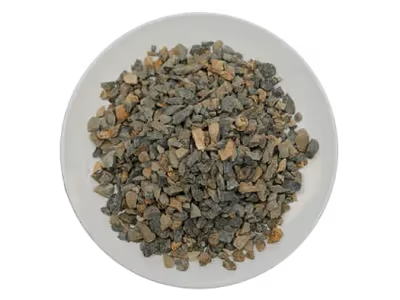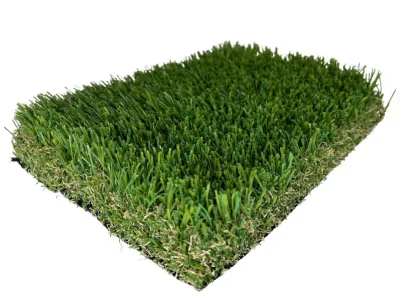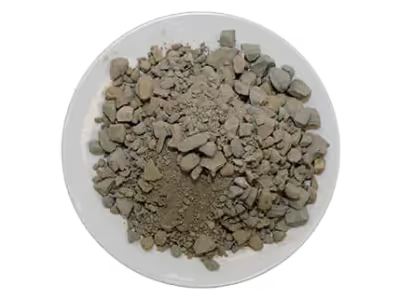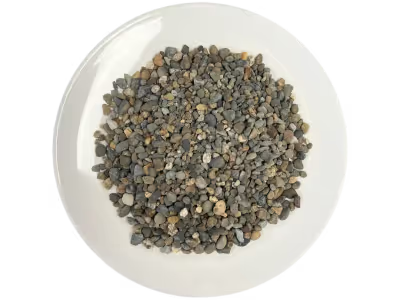
Whether you're laying a paver patio or installing artificial turf, the finished result is only as good as what's underneath. The short answer: build a compacted aggregate base—usually Class 2 base rock or decomposed granite—about 4 inches thick for patios (3–4 inches for turf), placed and compacted in thin lifts, graded to drain. Get the base right and your surface stays flat for decades; skip it and you'll fight settling, ruts, and cracks.
This is the exact prep process we walk customers through for long-lasting hardscape and turf.
Key Takeaways
- The base is the most important layer—nearly all failures trace back to it.
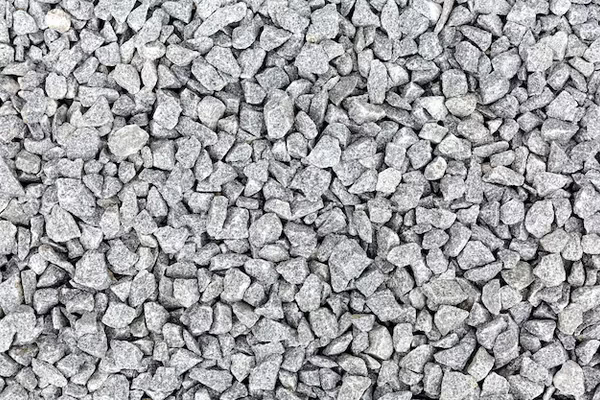
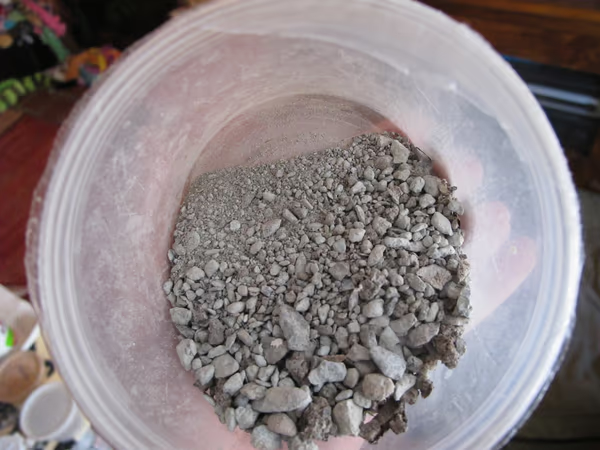
- Use compactible base rock (with fines) or DG, never clean drain rock.
- Build in 2–4 inch lifts and compact each one; dampen lightly for best density.
- Typical depth: ~4 inches (patios/walkways), 4–6 inches+ (driveways), 3–4 inches (turf).
- Grade to drain (about 1–2% slope) away from structures.
Materials and Tools
| Item | Purpose |
|---|---|
| Base rock (Class 2 / 3/4" minus) or decomposed granite | Compactible foundation layer |
| Concrete/setting sand | Thin bedding layer under pavers |
| Weed barrier | Under turf (and optional under pavers' edges) |
| Turf infill | Brushed into turf fibers after install |
| Plate compactor | Achieves full density in lifts |
| Rake, screed, level, measuring tape | Grading and leveling |
Get base materials on our Aggregates & Sands page. Not sure which rock? See base rock vs. drain rock—for a base you want fines that compact, not clean drainage rock.
Step-by-Step: Building the Base
Step 1: Excavate
Remove sod, soil, and debris to the depth of your base plus the surface layer. For a paver patio that's roughly base depth (≈4 in) + sand (≈1 in) + paver thickness. For turf, excavate about 3–4 inches for the base plus the turf. Account for the finished height matching adjacent surfaces.
Step 2: Grade and slope for drainage
Shape the subgrade with a slight slope—about 1–2% (roughly 1/4 inch per foot)—away from any structure so water sheds rather than pools. This single step prevents most drainage headaches later.
Step 3: Compact the subgrade
Run a plate compactor over the bare soil first. A firm subgrade keeps your base from sinking into soft ground.
Step 4: Add base rock in lifts
Spread base rock or DG in 2–4 inch lifts. Don't dump it all at once—compacting one thick layer leaves the bottom loose. Lightly dampen each lift; slightly moist material reaches far higher density (see compaction).
Step 5: Compact each lift
Run the plate compactor over each lift until the material stops moving and the surface is tight and even. Add the next lift and repeat until you reach full depth—~4 inches compacted for patios/turf, more for driveways.
Step 6: Final screed and check
Screed the surface flat (for pavers, to your sand layer; for turf, to a smooth, even grade), checking slope with a level. The base should be firm, flat, and draining before you go further.
Step 7: Finish the surface
- Pavers: add ~1 inch of screeded setting sand, lay pavers, then sweep jointing sand and compact.
- Artificial turf: roll out a weed barrier, lay and secure the turf at the edges, then brush in infill to weigh it down and stand the fibers up.
Common Mistakes to Avoid
- Using clean drain rock as a base. It won't compact—use base rock with fines.
- One thick lift. Always build and compact in 2–4 inch layers.
- Compacting bone-dry material. A light dampening dramatically improves density.
- No slope. Flat or reverse-sloped bases trap water and cause heaving and puddles.
- Skipping the plate compactor. Hand-tamping rarely achieves enough density for a lasting surface.
How Much Base Material Do You Need?
Calculate base quantity with (length ft × width ft × depth inches) ÷ 324, and order a little extra because base rock loses volume as it compacts. Our how-much-material guide and estimator handle the math. Base rock is heavy—about 1.2–1.5 tons per cubic yard—so delivery is usually the practical choice.
Related Resources
- Base Rock, Compaction, Decomposed Granite, and Turf Infill glossary entries
- Base Rock vs. Drain Rock
- Sod vs. Artificial Turf
- How Much Rock, Gravel, or Mulch Do I Need?
- Shop Aggregates & Sands and Artificial Turf & Accessories
Conclusion: Build It Once, Build It Right
A flat, lasting patio or turf lawn starts with a clean, well-compacted, properly sloped aggregate base. Use compactible base rock or DG, build in thin lifts, dampen and compact each one, and grade to drain.
Tell us your dimensions and surface type, and we'll calculate the base you need. Contact us or call (916) 783-9177—we deliver base rock, decomposed granite, and sand throughout Roseville and Placer County.